You that old saw, "It's not a failure if you Learn something"?
I've always hated that statement. I try to learn from my failures, but failure is failure, and for something to fail means that I wasted time doing something, and time is really my most precious commodity.
So here's what has failed, and here's what I've learned.
1. I wanted to build an antenna that would cover 10m, 20m, and 40m. I failed because I didn't understand the nature of what I was building. Instead of making it small wavelength to big wavelength, I needed to make the calculations for the whole antenna first, and build the whole thing, then tune from the smallest wavelength to the biggest wavelength.
2. I attempted to operate from the field (work parking lot) twice this last week, both times was a bust. My semi-success with the 4SQRP outing in October. I had to learn lessons there too, like, easy setup is more important than antenna efficiency in times of expediency. I think something like the St Louis vertical, or the St Louis Loop is a better choice for time sensitive ops, where the W3EDP is a better choice for times when you have time to set up. As an operational note, W1AW was 599 to my QTH on 40m Monday night.
3. Right now, I'm building a dummy load out of 2 watt resistors. 44 of them in parallel to be exact. Even that has had "Learning opportunities", namely when it comes to lining holes up. That has changed from being something pretty and elegant to downright ugly. I just want it to work.
Tonight, I think I might just go to bed, leave the soldering iron cold...
sigh.
or maybe I won't...
stay tuned!
73
Showing posts with label experiments. Show all posts
Showing posts with label experiments. Show all posts
Wednesday, February 6, 2013


Tuesday, January 29, 2013
Short Note on RF Absorption and Coil Forms
Recently, on the "Glowbugs" google group, there was a discussion about whether a pill or vitamin bottle was suitable for use as a coil form for a tank curcuit, or other more general RF use (loading coil form, etc).
According to that fine bunch of OMs and YLs, the test is temperature after being microwaved for a bit. Here's how the test works:
1. Take a microwave safe dish, and put a cup of water in it. Make sure dish is shaped so that both dish and test bottle can fit in the microwave oven without one being on top of the other.
2. Clean and dry the container you want to test. I tested a bottle that held fiber, that's what's in the picture. Trickiest thing about the prep work on this baby is that you want to make sure all the metal from the freshness seal is removed from the rim.
3. Place both the test bottle and the cup of water in the microwave. Take note of the temperature of each, "room temperature" is as precise as this measurement needs to be.
4. Nuke it for a minute. (see below for further advice)
5. Compare temperatures: the test bottle should still be at room temperature, and the water should be noticably hotter (scalding hot on some microwaves, so be aware!)
According to that fine bunch of OMs and YLs, the test is temperature after being microwaved for a bit. Here's how the test works:
1. Take a microwave safe dish, and put a cup of water in it. Make sure dish is shaped so that both dish and test bottle can fit in the microwave oven without one being on top of the other.
2. Clean and dry the container you want to test. I tested a bottle that held fiber, that's what's in the picture. Trickiest thing about the prep work on this baby is that you want to make sure all the metal from the freshness seal is removed from the rim.
3. Place both the test bottle and the cup of water in the microwave. Take note of the temperature of each, "room temperature" is as precise as this measurement needs to be.
4. Nuke it for a minute. (see below for further advice)
5. Compare temperatures: the test bottle should still be at room temperature, and the water should be noticably hotter (scalding hot on some microwaves, so be aware!)
 |
| Them what was tested. |
Above is my test bottle, a repurposed fiber containment vessel. Errr, it's not mine man... I'm to young to take a fiber supplement! (maybe...)
K5KVH had mentioned the RF microwave test, and this is what hed had to say way back in 2011 on the Glowbugs list:
PVC is easy to verify if it has additives to increase loss. You can
check your PVC easily with the microwave test. Put a sample of the pvc
on a paper towel in the microwave oven. Put a cup of water in there
next to it. (no metal trim on cup, plain china).
Set the microwave to 3 or 4 minutes. When you see the water is boiling,
stop the oven. Carefully test the pvc with a wet finger tip, to see if
it got warm, ie warmer than the hot air around the cup.
If not, it is good for HF for sure. This is based on a formula for
dielectric loss that shows such loss is directly proportional to
frequency, the higher the test frequency, the higher the loss would be
for a given material. Thus, no heating at microwaves means it is
a good insulator at HF.
Ok, I will buy that.
My test results indicate that this material is good for winding tank circuits, or whatever, at HF frequencies.
It is made of "Recycle Material Number 2", ie High Density Polyethylene (HDPE).
I recently acquired some more tubes, so I'm probably going to be using this soon.
I also have pillbottles.
73!
Saturday, May 5, 2012
The Antennas on the Antenna Farm
Hey,
So my food garden is stinking right now. Not really stinking, I just got to figure out the magic in my yard. I get a lot of shade from the neighborhood trees. That makes for great fun for the kids playing in the back yard, but it doesn't help me growing anything at all.
That's another blog for another day.
Having a big tree in the back yard is useful for antennas though, especially if you are as much of an antenna junky as I am. Antennas to me, represent the greatest opportunity for doing something new. I can't go out and buy all the kits, and cool radios, but I can get some speakerwire, old buttons, used pulley, tarred nylon string, paracord, or whatever, and have some fun. A tree is an environmentally friendly antenna tower! Just add wire.
There are some things to remember about trees that will affect your antenna performance.
1. Touch the tree as little as possible with the wire. A tree is a living thing full of electrolytes in solution, and electrolytes in solution conduct RF! That means your tree can detune your antenna if it touches it. During the spring, some people even go as far as to intentionally try to load the tree itself and use it as an antenna. I've never done it, and I don't plan on it. I have enough fun with speaker wire as it is.
2. Trees that are drought stressed get weak after a heavy rain. Basically, they suck up a lot of water, and get top heavy quick. Couple that with waterlogged dirt, and if it's an ongoing wind event (like a hurricane) and it becomes easy for trees to become uprooted. Practice safety at all times! Try to make sure there is a weakpoint in your achoring system so that if the tree does go over, it will break, and won't cause damage from an anchor point pulling out.
3. As an extension of rule 1, reduce transmit power. I don't have the capability to go over 100w right now anyway, so that's fine by me. Amateur rules and regs (Part 97.313) tell us to use only the minimum power necessary to carry out reliable communication anyway. Remember the tree is alive, and too much RF is generally bad for any living creature.
4. Expect the tree to detune the antenna some. This is another application of the principles I explained in rule #1.
With those rules in mind, here are some pictures:

This is my 2m/70cm dualband copper J-pole. Yeah, I know they aren't supposed to work, but it's what I use to hit the local stuff! I had fun making it, and I have fun using it. No I don't get any RF in my shack from it.
Who knew, right? It is mounted on an old TV antenna pole that came with the house. I moved the pole from right smack in the way outside the back door to the shack. I've used it to talk to all the local 2m repeaters using 5w on my Kenwood mobile turned shack radio.
 This is another j-pole, built for 10m. As soon as I got it deployed 10m activity dried up, lol. I don't have a real measure of how well it does yet. I've used a 'super-j-pole' on 10m before, and had great results. I couldn't quite get the line high enough to deploy that antenna, so I rolled it back up, and homebrewed up a quick regular style replacement. I got the design from this site: http://kk1cw.tripod.com/buildyourownwireant.html So far, that page has been a valuable resource for me. He has several downloadable spreadsheets that you can use to calculate how to build various antennas, not just j-poles.
 In the middle of the branch that runs left to right is a white object. That object is the balun for my 40m dipole. From there, one leg runs North by Northwest, and the other runs East by Southeast. The vee in the horizontal plane is very wide. This antenna was the first antenna for HF I ever purchased. I got in Atlanta at Ham Radio Outlet, and originally deployed it in the attic of the church where I worked at the time. I lived next door, and if I wanted to get active, I had to go upstairs, and use the antenna there.
 Same antenna, but I faced north, looked up, and shot the pic, so you could get an idea of how it runs. The line that runs across the open area is the antenna. The pic of the other side of the dipole didn't quite turn out.
That leg kind of disappoints me. It somehow got trapped on these little scraggly branches on a limb and slopes down before leveling off and running east. Nomatter my efforts, I can't seem to free that leg. If I did, no bare wire would be touching any part of the tree.
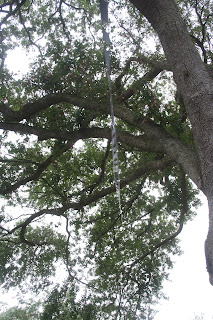 Here's the previously mentioned deployed W3EDP. My back is to the shack, and I'm facing east.
Not pictured is my 15m vertical loop. I'm considering taking it down, and reusing the mounting point for another antenna, either another loop (20m instead of 15) or using it as an experimental platform.
I need more trees!
So my food garden is stinking right now. Not really stinking, I just got to figure out the magic in my yard. I get a lot of shade from the neighborhood trees. That makes for great fun for the kids playing in the back yard, but it doesn't help me growing anything at all.
That's another blog for another day.
Having a big tree in the back yard is useful for antennas though, especially if you are as much of an antenna junky as I am. Antennas to me, represent the greatest opportunity for doing something new. I can't go out and buy all the kits, and cool radios, but I can get some speakerwire, old buttons, used pulley, tarred nylon string, paracord, or whatever, and have some fun. A tree is an environmentally friendly antenna tower! Just add wire.
There are some things to remember about trees that will affect your antenna performance.
1. Touch the tree as little as possible with the wire. A tree is a living thing full of electrolytes in solution, and electrolytes in solution conduct RF! That means your tree can detune your antenna if it touches it. During the spring, some people even go as far as to intentionally try to load the tree itself and use it as an antenna. I've never done it, and I don't plan on it. I have enough fun with speaker wire as it is.
2. Trees that are drought stressed get weak after a heavy rain. Basically, they suck up a lot of water, and get top heavy quick. Couple that with waterlogged dirt, and if it's an ongoing wind event (like a hurricane) and it becomes easy for trees to become uprooted. Practice safety at all times! Try to make sure there is a weakpoint in your achoring system so that if the tree does go over, it will break, and won't cause damage from an anchor point pulling out.
3. As an extension of rule 1, reduce transmit power. I don't have the capability to go over 100w right now anyway, so that's fine by me. Amateur rules and regs (Part 97.313) tell us to use only the minimum power necessary to carry out reliable communication anyway. Remember the tree is alive, and too much RF is generally bad for any living creature.
4. Expect the tree to detune the antenna some. This is another application of the principles I explained in rule #1.
With those rules in mind, here are some pictures:

This is my 2m/70cm dualband copper J-pole. Yeah, I know they aren't supposed to work, but it's what I use to hit the local stuff! I had fun making it, and I have fun using it. No I don't get any RF in my shack from it.
Who knew, right? It is mounted on an old TV antenna pole that came with the house. I moved the pole from right smack in the way outside the back door to the shack. I've used it to talk to all the local 2m repeaters using 5w on my Kenwood mobile turned shack radio.


That leg kind of disappoints me. It somehow got trapped on these little scraggly branches on a limb and slopes down before leveling off and running east. Nomatter my efforts, I can't seem to free that leg. If I did, no bare wire would be touching any part of the tree.

Not pictured is my 15m vertical loop. I'm considering taking it down, and reusing the mounting point for another antenna, either another loop (20m instead of 15) or using it as an experimental platform.
I need more trees!
Subscribe to:
Posts (Atom)